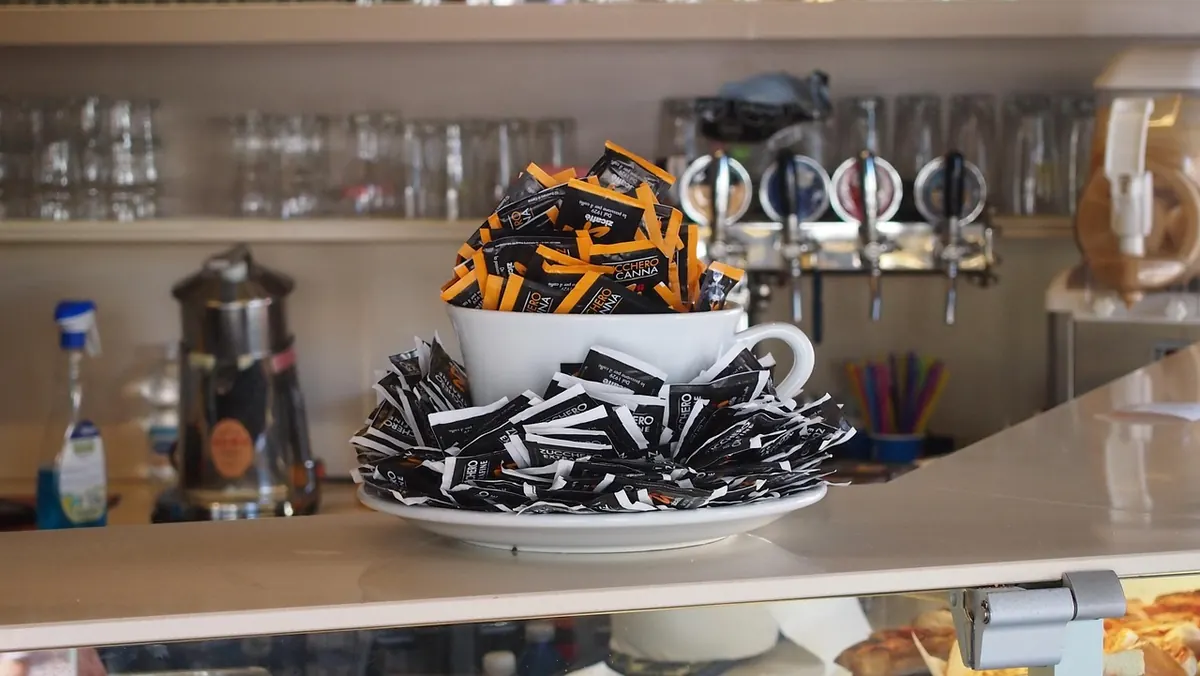
The whole thing takes about ninety seconds. A door, a word, a small cup, a nod to whoever is standing next to you, and you are back on the pavement with your change in your pocket. There is a hiss of steam, the knock of the portafilter against the knockbox, a quick exchange between the cash desk and the machine, and then the cup is in front of you before you have finished deciding whether to add sugar. Italy runs on this pause — mid-morning, after lunch, between two errands — and like most deeply ingrained habits, it has never needed explaining to anyone born here. It only gets interesting when you try to explain it to everyone else.
Before the machine: coffee arrives in Venice
Coffee came to Italy through the trading ports of the Mediterranean, above all Venice, which by the late sixteenth century had regular contact with the Ottoman world. It was sold first in pharmacies and apothecaries, somewhere between a medicine and a curiosity, and only later became a drink. At the beginning it was not a democratic habit. It was expensive, strange, dark, and discussed by people who liked to discuss things. The coffee houses followed, and they were not quiet places. They were rooms for arguing: merchants, students, gondoliers, noblemen and spies sharing tables, reading newssheets, gambling and starting quarrels. A Venetian coffee house in the eighteenth century could be a reading room, a stock exchange, a gambling den and a rumor mill in the same afternoon.
The date that still hangs on a sign is 1720, when Caffè Florian opened under the arcades of Piazza San Marco. It is still there, and still charging for the orchestra. But the important point is not the famous café — it is the ordinary ones behind it. By the eighteenth century, coffee in Italy had stopped being exotic and started being routine, and a routine needs to be fast.
The invention of the ninety-second coffee
For a long time the fast part was impossible. Coffee was boiled, or made in a flip pot called the napoletana — pleasant, but slow, and closer to a strong brew than to a shot. The change came from Turin, where Angelo Moriondo patented a steam-driven machine in 1884; from Milan, where Luigi Bezzera reworked the idea at the start of the twentieth century; and from Desiderio Pavoni, who bought the patent, showed the machine at the Milan fair in 1906 and sold the result as caffè espresso — coffee made expressly for the person who ordered it, forced out by pressure. The early machines were not elegant counter fixtures. They were vertical boilers, complicated and expensive, built for cafés with capital and for customers in a hurry.
Two more steps gave us the ritual as it stands. After the Second World War, lever machines produced the thick hazelnut foam Italians call crema. And back in 1933, Alfonso Bialetti had already put a stovetop version, the moka, into millions of kitchens, so that even people who never set foot in a bar could have a small, fierce coffee at home. The bar machine and the moka did different jobs: one was public speed, the other domestic ritual. Together they made coffee a daily fact rather than a treat.
What you get when you ask for "un caffè"
Ask for un caffè in Italy and you have asked for an espresso: roughly a mouthful, brewed to order, served in a small preheated cup under a dark cap of crema. It is not a short version of something else. It is the default. The word espresso does not describe a bean or a roast; it describes a method and a moment — coffee made expressly for you, under pressure, and handed over while the foam is still alive.
The vocabulary around it is where visitors lose their footing:
- Ristretto — less water, shorter shot, more concentrated. The safest order if you like your coffee fierce.
- Lungo — more water through the same dose; lighter, longer, still small.
- Macchiato — "stained" with a drop of milk, hot or cold. It is not a latte with a splash of coffee.
- Corretto — corrected with a little grappa, sambuca or brandy. A winter order, and a generous one.
- Cappuccino — a big, milky cup. In practice, breakfast.
- Decaffeinato, or un deca — decaf. Also orzo and ginseng, roasted barley and ginseng drinks that stand in for coffee.
The list could go on — regional variations, coffee with cocoa, coffee in a glass — but the core is small and consistent. The barista is not waiting for a paragraph. A name or two is enough.
The rules nobody prints on the wall
No law governs this, but there is something close to a consensus, enforced quietly by the barista and the queue behind you.
- Work out whether you pay first. In most bars you take a receipt from the cassa and hand it to the person at the machine; in others you drink first and settle at the till on your way out. Watch the person ahead of you. It takes three seconds. If you pay first, keep the receipt visible. It is not a souvenir.
- Stand at the counter. Sitting at a table often costs more — sometimes much more — because you are paying for the table, the waiter and the square outside, not the coffee. In Venice, sitting on Piazza San Marco is a different sport entirely.
- Say the name, not a sentence. "Un caffè, per favore" is complete. Long explanations belong in pharmacies. If you want it stronger, say ristretto; if you want a drop of milk, say macchiato. The barista does not need your life story before the steam.
- Drink it there. The cup is small because it is meant to be finished standing up, in two or three sips, while the crema is still alive. If you need to linger, order another or choose a café designed for sitting.
- Keep cappuccino for the morning. Most Italians regard a milk-heavy coffee after a meal as a small digestive heresy. Nobody will arrest you, but the barista may smile. If you genuinely want milk later, ask for a macchiato; it is the compromise.
- Learn the rush-hour choreography. At eight in the morning or half past ten, the bar is not a co-working space. Step aside after ordering, keep the queue moving, and do not occupy the machine area while deciding what you want. The whole ritual depends on nobody treating ninety seconds as an hour.
The bar as a social institution
The espresso bar is not a café in the French sense, and it is certainly not an office with better lighting. It is standing room, mirrors, brass, a few stools and a counter. The barista is not quite a server and not quite a stranger; regulars are recognized, and "il solito?" — the usual? — is the highest compliment the room can pay. The break punctuates the day: mid-morning, after lunch, before a train, after an argument, before a meeting. It is cheap by international standards, especially at the counter, though prices vary and tourist squares cost what tourist squares always cost. But the social function is not cheap at all. It is a public pause, available to almost anyone, requiring no reservation and no performance.
The espresso break is not really about caffeine. It is about inserting a small, public pause into a private day.
Why the ninety seconds survived
Italy now has specialty coffee, brunch, oat milk and queues for flat whites. It also has automatic machines in offices and capsules at home. Yet the bar espresso persists because it is efficient and social at the same time. The moka belongs to the kitchen and the family; the bar belongs to the street and the city. The break survives because it fits between things. It requires almost no money and almost no decision. It is the opposite of a meeting. You can do it alone without looking lonely, or with a colleague without making an appointment. In a country that can be formal about meals, coffee remains informal. The ninety seconds are not stolen from work; they are part of the day's punctuation.
So the hidden history of the espresso break is not hidden in archives. It lives in the gesture: the door, the word, the cup, the nod. It was built by traders and inventors and machine-makers, but it is kept alive by people who would never call it a ritual. They just know that the day goes better with a small, hot pause in the middle of it.
Photo: ahundt / Pixabay