Most people own a sky they never really look at. We notice a full moon, maybe a bright meteor, and then go back inside. But a surprising number of genuinely strange sights are available to anyone with clear weather, a horizon, and twenty minutes of patience — no telescope, no equipment, no trip. Some are seasonal, some are rare, and all of them reward the habit of stepping outside at the right hour.
What follows is a working checklist rather than a lecture. Each entry tells you what you are looking at, when to try, and what will ruin the view.
Start With Twilight: The Belt of Venus and Earth's Shadow
The easiest phenomenon on this list happens on almost any clear evening, and most people have never named it. Turn your back on the setting sun and look at the eastern horizon. A blue-grey band will be rising there — that is Earth's shadow, projected onto the atmosphere. Above it sits a soft pinkish strip, the Belt of Venus, catching light that has traveled through the lower atmosphere.
Timing matters more than location. Give it ten to twenty minutes after sunset, and the same window before sunrise works in reverse. The pink band fades fast, usually within half an hour, so this is not a sight you can drift toward. Any rooftop or field with a clean eastern horizon is enough.
Green flashes, honestly assessed
If you have a sea horizon or a flat plain, watch the last sliver of the sun at sunset. Occasionally a brief green point appears for a second or two as the sun's disc disappears. It is real, it is optical, and it is uncommon — you may watch fifty sunsets and see nothing. Never stare at the sun before it is at the horizon; wait until it is almost gone.
Ice in the Air: Halos, Sundogs and Light Pillars
Cold weather brings some of the most photogenic oddities in the sky, because ice crystals behave like tiny prisms. Look for these on days when the air is crisp and there are thin, wispy clouds high up — cirrus, or a light haze.
- 22° halo. A ring around the sun or moon at roughly the width of two hand spans held at arm's length. Common, often missed because we avoid looking near the sun. Shield the sun with your hand or a building edge.
- Sundogs. Bright patches to the left and right of the sun, at the same height. They appear in genuinely cold, hazy weather and can briefly look like a second sun.
- Sun pillars. Vertical shafts of light above a low sun at sunrise or sunset, or above streetlights on very cold nights. Caused by flat crystals near the ground reflecting light.
- Moon dogs and lunar halos. The same optics at night, subtler and often striking against a dark sky.
The practical rule: when the forecast says "cold and hazy," go outside. These displays are usually gone within twenty minutes once the crystal layer thins.
Noctilucent Clouds: The Summer Anomaly
These are the strangest clouds most people will ever see. They form roughly eighty kilometres up, far above ordinary weather, and glow electric blue-white against a dark sky well after sunset. They look like rippled silk or a thin lattice of veins, and they are only visible in a narrow seasonal window.
In the Northern Hemisphere, try from late May through late July, at latitudes roughly between 50° and 65° — northern Europe, Canada, northern Britain, the Baltic. Go out about an hour after sunset, or an hour before sunrise, when the sun is below the horizon but still lighting those high crystals. You need a clear northern or north-western horizon and, ideally, a night with no low cloud. Some years produce spectacular displays; some produce almost nothing. That unpredictability is part of the appeal.
Meteor Showers Worth Planning Around
Meteors happen every night, but a handful of showers give you a genuine reason to set an alarm. Rates vary year to year, and the moon can wash out an otherwise good shower, so check the phase before committing.
- Quadrantids — early January, short sharp peak.
- Lyrids — late April.
- Eta Aquariids — early May, best before dawn.
- Perseids — around 12 August, the reliable summer favourite.
- Orionids — late October.
- Leonids — mid-November.
- Geminids — around 13–14 December, often the strongest of the year.
Skip the peak-hour obsession. The best viewing is usually the two or three hours before dawn, when the radiant is high and the sky is darkest. Lie back, let your eyes adjust for twenty minutes, and watch a wide patch of sky rather than hunting for the radiant point.
The Faint Sights: Zodiacal Light, Gegenschein and Andromeda
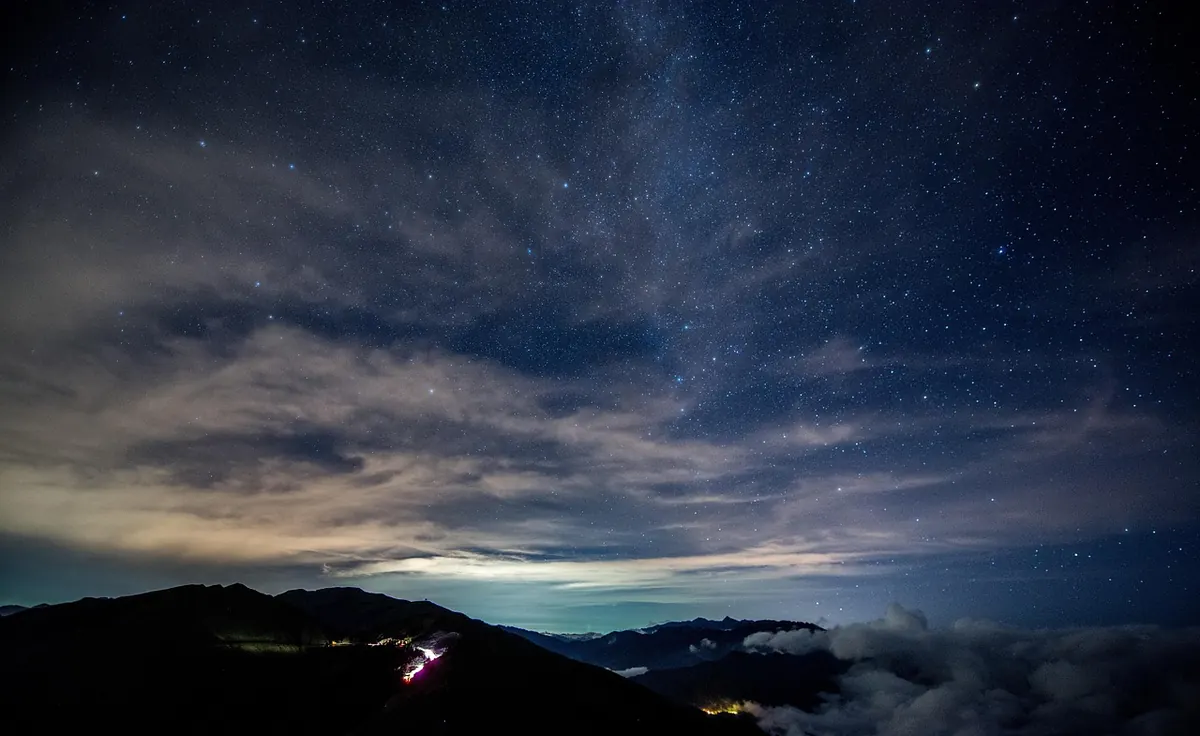
These three require something the previous entries do not: a genuinely dark sky, away from streetlights. If you can see the Milky Way, you have a chance.
The zodiacal light
A soft pyramid of light rising along the ecliptic, caused by dust in the inner solar system. It is best around the equinoxes: in spring, look west after evening twilight ends; in autumn, look east before dawn. The window is short — roughly an hour after sunset or before sunrise — and any haze or moon will erase it.
The gegenschein
A very faint oval glow directly opposite the sun, essentially backscattered sunlight from the same dust. It needs a dark site, no moon, and averted vision: look slightly to the side and it appears, look straight at it and it vanishes.
Andromeda, naked-eye
In autumn evenings, find the constellation Cassiopeia, then follow the line of stars toward the square of Pegasus. The fuzzy smudge between them is the Andromeda galaxy, about two and a half million light years away. Binoculars make it obvious; your eyes alone make it eerie, which is the point.
The Moon and Planets Doing Odd Things
Some of the best sights need no special season at all, just a glance at the right time.
Earthshine is the faint glow on the dark part of a crescent moon, sunlight reflected off Earth's clouds and oceans. It is strongest in spring and autumn, when the crescent hangs low after sunset.
The Moon illusion is the trick where a rising moon looks enormous. It is not bigger; photograph it near the horizon and compare with a shot taken a few hours later. The effect is worth experiencing even knowing it is a quirk of perception.
Conjunctions are close pairings of planets and the moon, appearing as two bright points inches apart. Venus at its brightest as an evening or morning star is hard to mistake — it is the brilliant object that hangs in twilight long after the stars appear.
A Practical Checklist Before You Go Out
- Check three things: cloud cover, moon phase, and light pollution at your chosen spot. A bright moon will defeat the faint sights entirely.
- Give your eyes twenty minutes. No phone screens, no car headlights, no porch lights. Red light if you need a torch.
- Bring a horizon. Twilight phenomena and green flashes need an unobstructed view low down; a hilltop or a coast beats a back garden.
- Take binoculars if you own them. Even modest 7x50 or 10x50 pairs transform the Andromeda galaxy, the Pleiades and lunar craters.
- Dress for standing still, which is much colder than walking. A flask helps.
- Write down what you saw and when. A few lines a week turns into a personal record of the sky, and next year you will know exactly which nights to try again.
None of this requires a dark-sky reserve or a clear weekend. It requires knowing which hour to be outside, and being willing to look at the part of the sky that is not the moon.
Photo: Pexels / Pixabay